
For many young people in Singapore, social media is part of everyday life. It can help them connect and learn, but it can also affect sleep, relationships and emotional wellbeing when use becomes difficult to control or begins to displace other important activities.
On 30 July 2026, Singapore’s Ministry of Health said its Expert Panel on the Mental Health Impact of Social Media Use had submitted findings and recommendations to the Government. The Panel’s concern is not simply how long young people spend online, but how they use social media, what they encounter and what online activity replaces.
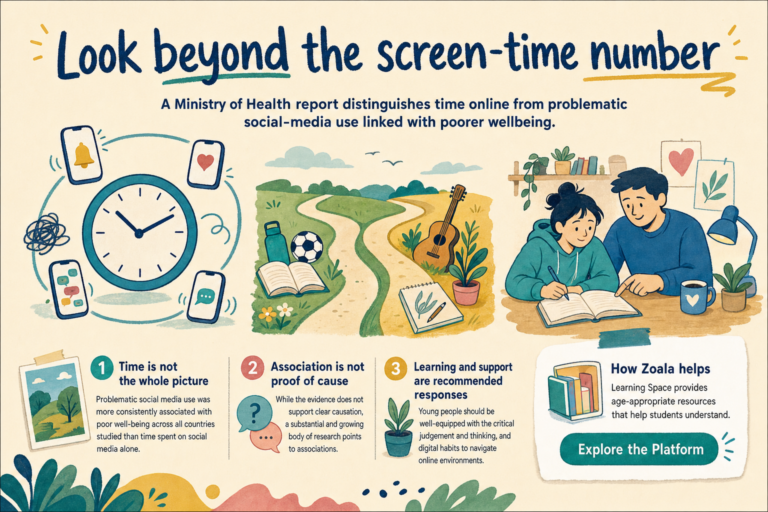
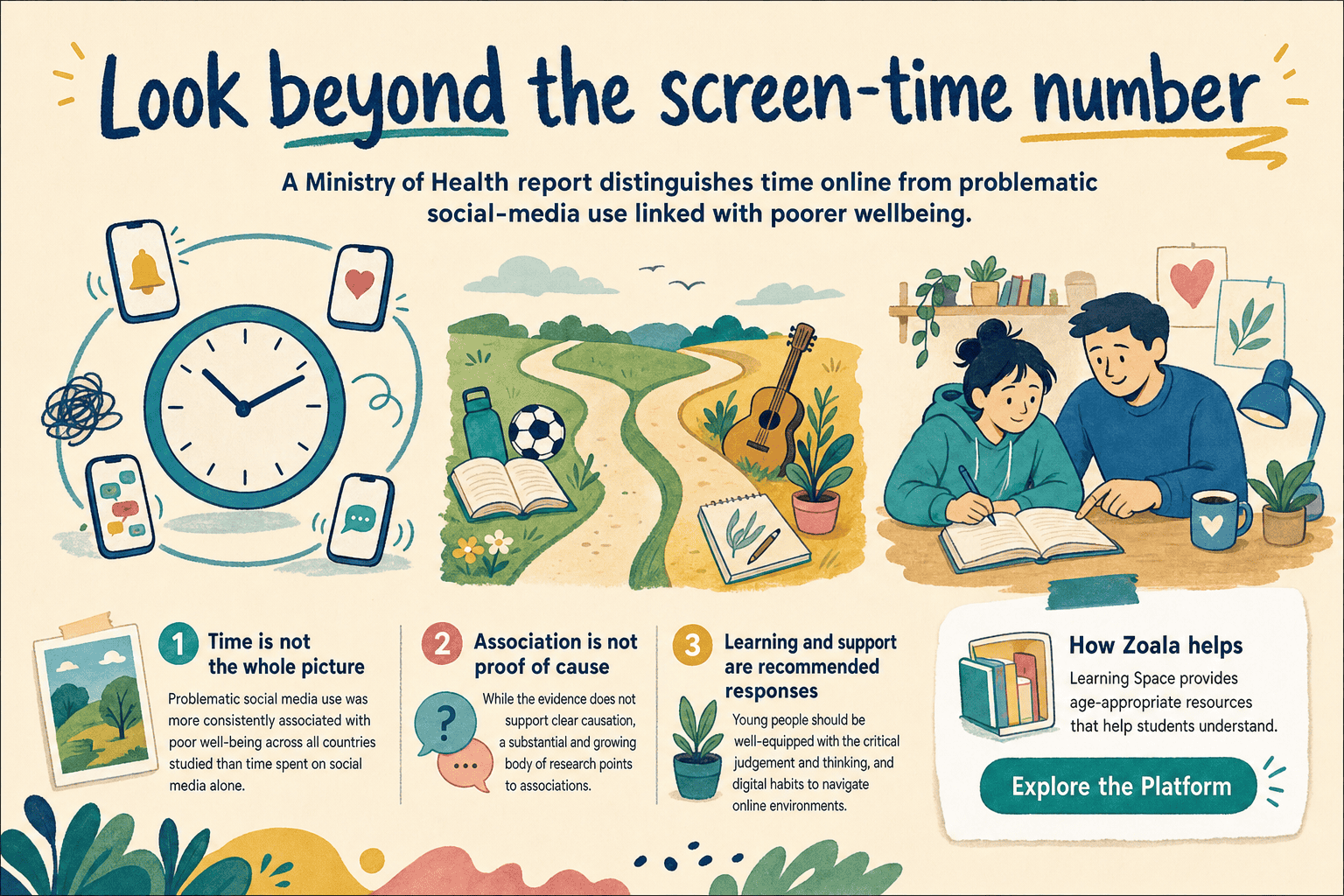
Time online is not the whole story
The Expert Panel makes an important distinction between excessive and problematic social-media use. Time spent online describes duration. Problematic use refers to persistent, compulsive or addiction-like patterns that may be harder to manage.
In Singapore, the report says that 36% of young people aged 15 to 17 reported spending more than three hours on social media daily. It also says that 18% of young people aged 10 to 24 showed signs of problematic social-media use. These figures cover different age ranges and should not be read as a diagnosis or as a measure of all school pupils.
The report also stresses that current evidence does not establish clear causation between social-media use and adverse mental-health outcomes. Instead, it describes a growing body of research showing associations with concerns including anxiety, depression, lower life satisfaction, body-image concerns and problematic eating behaviours.
That distinction matters for schools in Singapore and for school communities across Malaysia, Hong Kong and Indonesia. A student who spends several hours online is not automatically experiencing a wellbeing concern. Equally, a short amount of time online does not tell adults everything they need to know. Context, relationships, sleep, learning experiences and the student’s own voice all matter.
What can make online life harder?
The Expert Panel highlights several platform features that may create additional pressure for young people.
- Direct messaging can expose young users to cyberbullying, harassment or inappropriate contact.
- Infinite scroll and autoplay remove natural stopping points and may encourage longer use than intended.
- Algorithmically curated feeds may lead users towards distressing or harmful content.
- Visible likes and follower counts can encourage social comparison and validation-seeking.
These features do not affect every young person in the same way. Their effects may also interact with existing pressures, such as loneliness, academic demands, relationship difficulties or a lack of sleep. A supportive response therefore needs to look beyond a single number or online habit.
From concern to practical support
The Expert Panel recommends safer platform design, stronger age-assurance measures and better support for young people and parents. It also calls for young people to develop critical judgement and healthier digital habits, while recognising that no single intervention is enough.
For schools, this can begin with ordinary, repeatable opportunities to talk about online experiences without blame. A class discussion might explore how recommendation feeds work, how social comparison feels or how students know when they need a break. A pastoral conversation might ask what helps a student sleep, connect with others or step away from content that feels overwhelming.
Families, teachers, counsellors and school leaders each have a different role. Families can keep conversations open. Teachers can make space for digital wellbeing within learning and class activities. Counsellors can consider the wider context when a student asks for help. School leaders can make sure that support pathways are clear and that staff know how concerns should be reviewed.
How Zoala can complement this work
Zoala is a student wellbeing platform designed to help schools make emotional wellbeing part of everyday school life. It can complement digital-wellbeing education and existing school support processes, while human judgement remains central.
Learning Space: building understanding before concerns become harder to discuss
The Expert Panel recommends helping young people develop critical judgement and healthier digital habits. Learning Space provides age-appropriate resources about emotions, relationships, resilience and healthy coping. A school might use these resources alongside lessons or guided discussions about online life, social comparison and taking breaks.
Learning Space is educational support. It does not assess whether a student’s social-media use is problematic, diagnose a condition or replace professional support.
Zo: a low-pressure place to begin reflecting
Some students may find it difficult to start a conversation about online experiences, changing digital habits or difficult emotions. Zo, Zoala’s AI wellbeing companion, gives students a supportive space to reflect and talk through everyday challenges before considering an appropriate next step or speaking with someone they trust.
Zo supports general reflection and wellbeing conversations. It does not diagnose conditions, provide treatment, guarantee confidentiality or replace trusted adults, counsellors or emergency services. Information is handled according to the relevant privacy terms, school configuration and safeguarding procedures.
Teacher and Counsellor Portal: connecting information with human follow-up
When a student shares a concern, the next step should not be determined by one response or one pattern of digital behaviour. The Teacher and Counsellor Portal brings relevant wellbeing information, communication and follow-up workflows together for authorised school staff.
This can help a school organise its review process and consider what support may be appropriate. The portal does not make final safeguarding or clinical decisions. Authorised staff must consider context, professional judgement and the school’s established procedures.
A calmer way forward
The Singapore report provides a reason for schools to strengthen digital-wellbeing conversations, not to label students by their screen time. Its findings point towards a balanced response: safer online environments, practical education, open communication and accessible human support.
For readers in Singapore, the Expert Panel’s recommendations provide a direct local reference point. Schools in Malaysia, Hong Kong and Indonesia may also find the broader approach useful, while adapting it to their own communities, policies and support pathways rather than assuming that Singapore’s figures apply locally.
Zoala can support this work through learning resources, a reflective AI companion and organised staff follow-up. It is designed to add useful pathways around students and the people who support them—not to make conclusions about a young person’s wellbeing.
The most relevant next step for school leaders, counsellors and wellbeing coordinators is to explore how these tools can fit alongside an existing wellbeing programme.
Sources
- https://www.moh.gov.sg/newsroom/expert-panel-submits-key-findings-and-recommendations-to-support-healthier-and-safer-social-media-use-among-young-people
- https://go.gov.sg/expert-panel-report-on-social-media-use
- https://isomer-user-content.by.gov.sg/3/65ce50a5-9893-46bd-b134-cb9b257d36b1/Report%20on%20Findings%20and%20Recommendations%20of%20Expert%20Panel.pdf