
A reported case in Clarksville, Tennessee, involving a special-education teacher and a student with additional needs has renewed discussion about how schools prepare staff to respond to difficult situations.
FOX 17 News reports that Lavanda Rife was indicted in June 2026 on charges including child abuse, neglect, endangerment of a child under eight and assault. The alleged incident took place in April. Rife’s attorney has said that she maintains her innocence, and the case remains subject to due process.
The report says the incident involved alleged inappropriate physical contact with a student following behaviour in a hallway. It has also revived efforts to reintroduce a Tennessee bill that would provide additional training for teachers working with students in special education, including conflict resolution and de-escalation.
Why this matters beyond one case
Safeguarding concerns are difficult because they rarely fit neatly into one system. A child may show a change in behaviour. A teacher may face a situation that escalates quickly. A counsellor may hold information that another authorised staff member needs to understand. Each signal requires context, careful judgement and a clear next step.
For readers in Singapore, this conversation sits alongside local child-protection guidance. The Ministry of Social and Family Development maintains a resource titled Child Abuse Reporting Tools. Schools and early-childhood settings should check the current official guidance directly and follow the procedures that apply to their organisation.
The wider lesson is not that technology can decide what happened. It is that schools need clear routes for raising concerns, trained people who know their responsibilities and reliable ways to record what happens next.
Training is part of the safeguarding process
Training on de-escalation can help staff recognise when a situation is becoming more difficult and consider safer ways to respond. It should sit alongside practical guidance on communication, supervision, reporting, documentation and escalation.
Training cannot remove every challenging situation. Nor can it replace professional judgement. Schools still need to define who receives a concern, who reviews it first, when a safeguarding lead becomes involved and how the child’s voice is heard without placing responsibility on the child.
Educators also need support. Many school and early-childhood teams are doing important work with limited time and complex needs. A constructive safeguarding culture should help staff ask for advice early, record concerns accurately and access supervision when a situation is difficult.
What schools can review now
- Make reporting routes visible. Staff and students should know how to raise a concern and who will receive it.
- Clarify roles. A school’s safeguarding procedure should identify the person responsible for first review, escalation and follow-up.
- Keep information relevant. Share sensitive information only with authorised people who need it for their role.
- Record actions, not assumptions. A report should distinguish what was observed, what was said, what remains unclear and what action followed.
- Review training regularly. De-escalation, conflict resolution and safeguarding procedures need practice, not just a one-off briefing.
- Keep the child’s welfare central. A child’s account should be heard in an age-appropriate way, while trained professionals assess context and decide what happens next.
Where Zoala can support the process
We believe technology should strengthen human care, not replace it. Zoala is a student wellbeing platform that can help schools organise support pathways and relevant information while trained professionals remain responsible for safeguarding decisions.
Making support pathways clearer with SafeGuard+
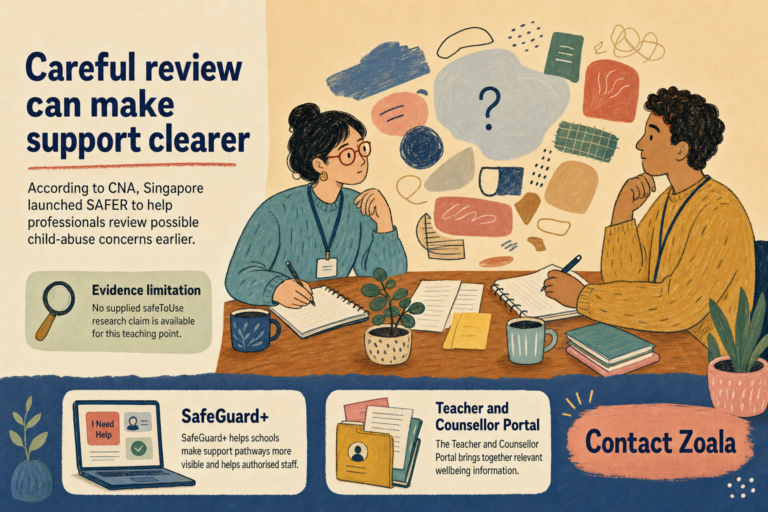
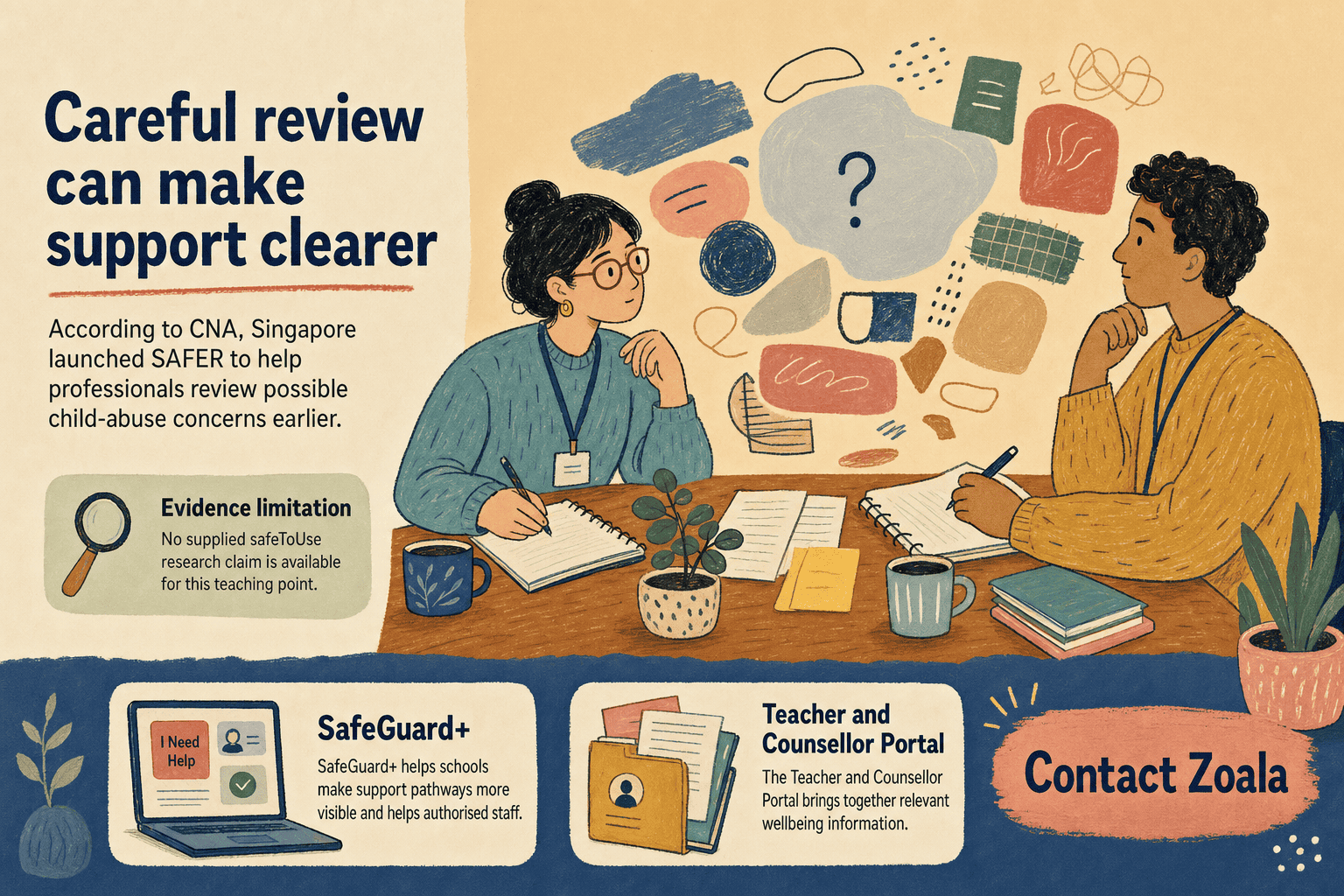
Early-childhood settings may need simple, visible routes for a student to ask for help or for authorised staff to review a possible concern. SafeGuard+ includes an “I Need Help” button, safety-plan functions and flagging and alerts for authorised school personnel. In practice, this can help a school make its agreed support routes easier to find and give authorised staff additional information to review.
SafeGuard+ does not provide emergency response, verify an allegation or guarantee that an intervention will take place. Schools must continue to follow their own safeguarding procedures and escalation arrangements.
Bringing relevant follow-up together
When a concern requires review, staff may need to bring together relevant wellbeing information, communication and follow-up records. The Teacher and Counsellor Portal provides a shared place for authorised school staff to organise these workflows.
The portal does not make a safeguarding conclusion or remove the need to speak with a child. Human professionals must consider the wider context, apply the school’s procedures and decide the appropriate next action.
Using alerts as signals for human review
Alerts can provide an additional signal when configured information may require attention. They may help authorised staff prioritise a review, but they do not prove that an event occurred, confirm harm or replace professional judgement.
Any alert should be considered alongside the available context. Some concerns may not create an alert, and some alerts may require further clarification. The school’s trained staff remain responsible for reviewing information, speaking with the student where appropriate and following the agreed safeguarding process.
A calmer, clearer next step
The Clarksville report has brought teacher preparation and de-escalation back into public discussion. For schools in Singapore and across the wider region, the practical response is to strengthen the link between training, reporting routes, authorised review and human follow-up.
If there is an immediate concern about a child’s safety, staff should use the school’s safeguarding procedure and contact the appropriate trusted professional or emergency service. Technology can help organise information, but it cannot carry the responsibility alone.
The most relevant next step for school leaders and wellbeing teams is to explore how Zoala supports schools.